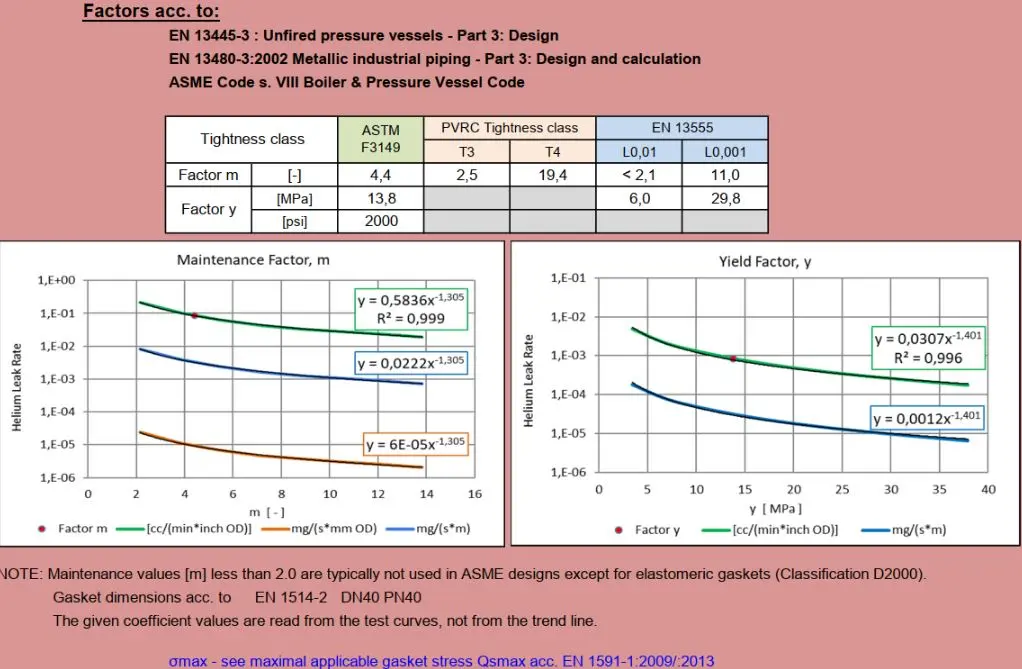
According to ASME we should simply use the coefficients from the ASTM F3149 column. By using the ASME algorithm we do not take into account the level of tightness that appears in the PVRC and EN 1591-1 algorithms, among others.
Some top seal manufacturers do add some useful data. They show more or less how the seal will behave during installation and operation. These pieces of information are not mandatory. Some designers use this data, but there is no guarantee that, for example, an inspector accepting the installation and calculations will agree with this approach.
Let's say that for the assumed class L 0.001. The value of "y" is read, in this particular case, as the intersection of the curve with the next higher tightness class - L 0.0001. And here it will be y = 6 MPa. We proceed similarly with the coefficient "m", which will give 11 MPa. These are very small values.
European standards have a completely different approach to the method of calculating the gasket and flange connection.
The graphs and tabular data for them are for informational purposes only. Using this data requires a lot of knowledge and caution.