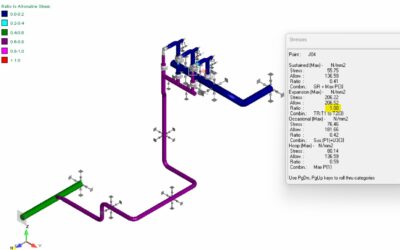
This type of fatigue is a phenomenon that should also be taken into account in pipelines, although it is most often associated with aviation technology. It primarily concerns process pipelines with large diameters greater than 250 with very high medium flow rates. The pressure drop on local resistances is proportional to the square of the speed, so at high speeds, very high high-frequency noise also appears due to their existence. It translates into circumferential vibrations of small amplitude but high frequency. As a consequence of this phenomenon (Acoustic Inducted Vibration AIV), the fatigue reserve of the pipeline material is quickly exhausted. The most vulnerable are flare pipelines, turbocompressor safety valves, locations of cross-sectional narrowings such as control valve heads, welded pipeline elements such as tees, weldolets and supports.
In the 1980s, Carrucci and Muller proposed a method for assessing the susceptibility of pipelines to AIV fatigue, which has been widely published. One of the main elements is a graph (valid only for a specific type of steel) estimating the range of safe operation of pipelines. It should be noted that according to it, the occurrence of the AVI phenomenon can be said to occur above 150 dB of acoustic power and for diameters greater than DN 250. This does not mean that in the case of a specific installation, the costs of which can be enormous for an emergency shutdown, these two boundary conditions should not be significantly reduced. As always, this depends on the knowledge and experience of the designer.

The whole problem is in correctly determining the value of the internal pressure of the acoustic wave generated inside the pipeline during the AIV phenomenon.
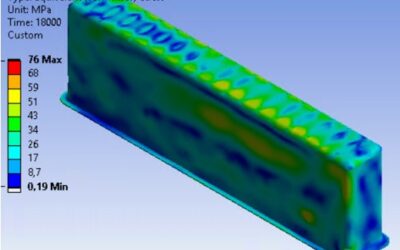
Below is a simple simulation of acoustic fatigue. This is a section of a pipeline fixed at both ends and subjected to internal pressure. The reduced stress in the pipeline sections varies with frequency. It has a maximum value at 1240 Hz.