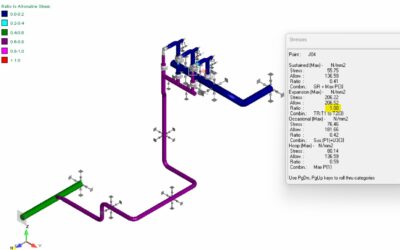
The bottleneck in the calculations is the strength of the nozzles. I have a few observations on how to deal with this.
The first rule is to increase the flexibility of the pipeline system by not blocking axial and lateral movement. In this case, there will always be a reaction force on the nozzle according to Newton's third law of dynamics.
The second rule, which is also related to Newton's Third Law, is to use low friction supports near the nozzles. Using a Teflon washer under the triunion will reduce the friction force three-fold and consequently the torque on the nozzle three-fold. The moment arm remains constant. Such applications have Lisega. Lisega for example

The third rule is to carefully model the triunions on the elbow. This is especially important for large diameters.

The fourth rule is to use springs at the top of vertical sections, especially when media temperatures are significant.